Ema: The Wooden Wish Plaques at Japanese Shrines
Quick answer
An ema is a small wooden plaque you receive at a Japanese shrine. You write a wish on the blank side and hang it on the shrine's rack, where it stays. Anyone can write one, in any language, English included. A name is fine. Leave off your address.
What an ema is
An ema (絵馬) is a small wooden plaque hung at a Shinto shrine. The usual shape is a pentagon, like a house with a pointed roof, about the size of your hand. One side carries a printed picture. The other side is left blank for you.
You receive an ema at the shrine’s juyosho, the counter where plaques, paper fortunes and other items are handed out. Shrines treat the money as an offering, not a price. The plaque is not a souvenir of the visit. It is part of it.
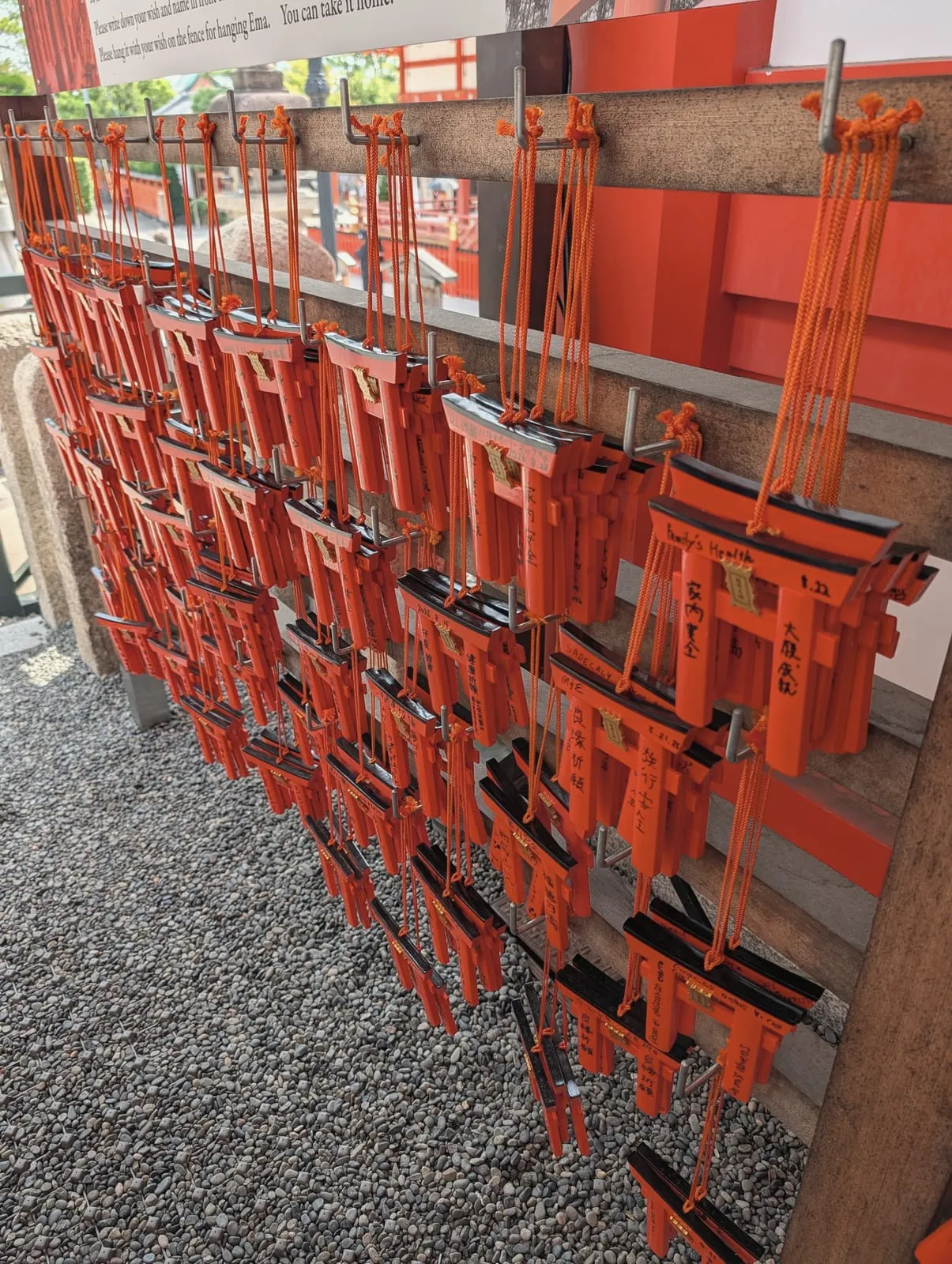
The shape changes from shrine to shrine. Some shrines offer heart-shaped ema. At Fushimi Inari, the two shapes you will see most are a small torii gate, like the ones in the photo above, and a fox’s face.
Where the name comes from
The word joins two characters: e (絵), picture, and ma (馬), horse. Shrines once received real horses as offerings. People who could not give a horse gave a picture of one instead, painted on wood.
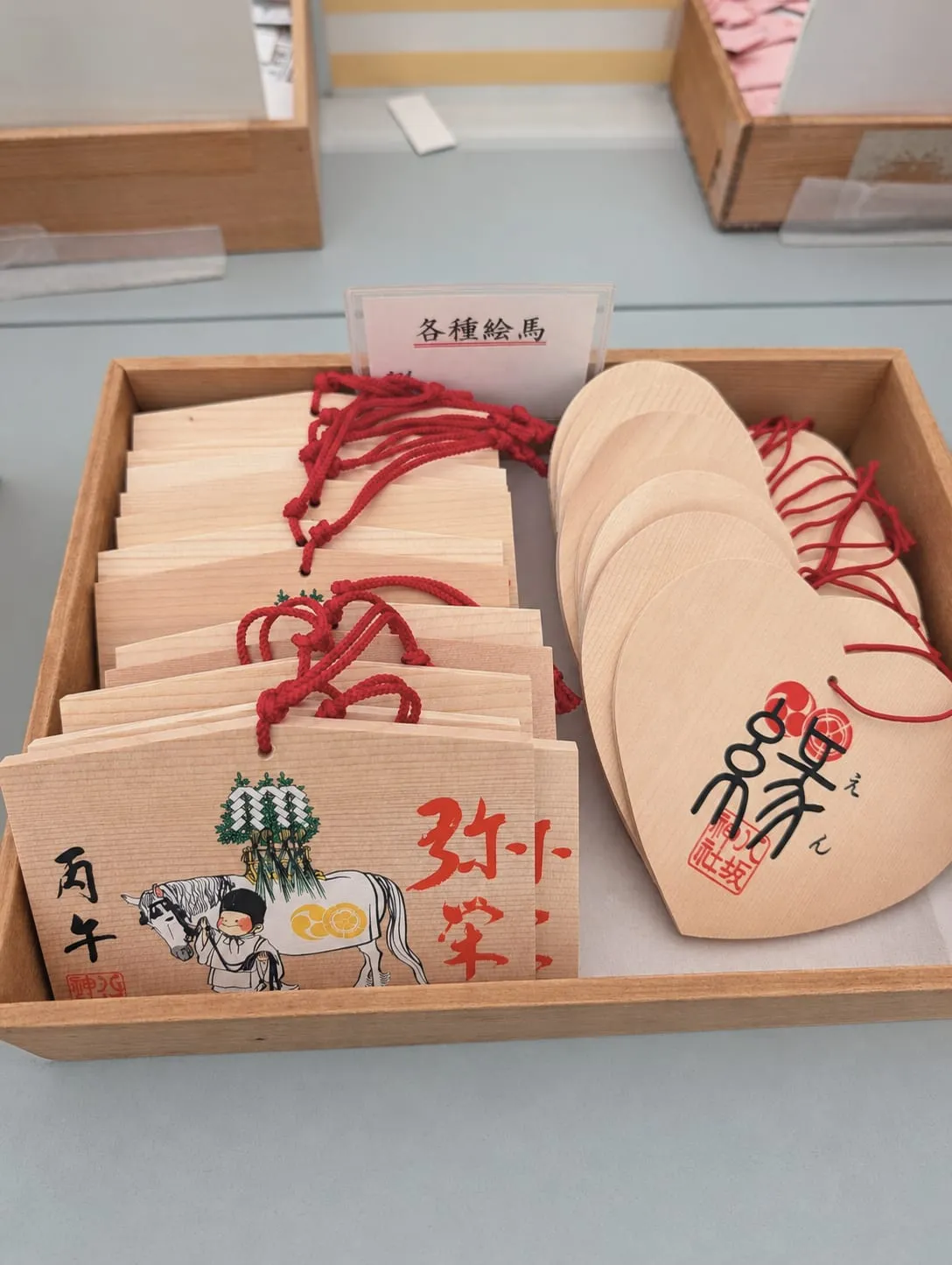
The board stayed, and the horse became optional. Some shrines still print one. The plaque on the left in the photo below carries a horse for 2026, the Year of the Horse. Most now print something tied to the shrine itself. At Fushimi Inari, where foxes are the messengers of Inari, that means a fox.
What to write
Most people write three things on the blank side: a wish, their name, and the date. The wish can be one line. Many are two or three words.
Write it so it can be read at a glance. Ema hang close together, often three or four deep on one hook, and the ones at the back show only their edges. Larger letters in the middle of the board hold up better than small ones near the cord.
Ema hang in the open, facing the path, and anyone walking past can read them. Names are common. Addresses and phone numbers are not, and we would leave them off.
Any language is fine. On the racks at Fushimi Inari, English sits next to Japanese. Write in your own words. There is no set form.
These are the more common shape, next to a heart. This tray is from Yasaka Shrine in Gion.
One we wrote at Fushimi Inari
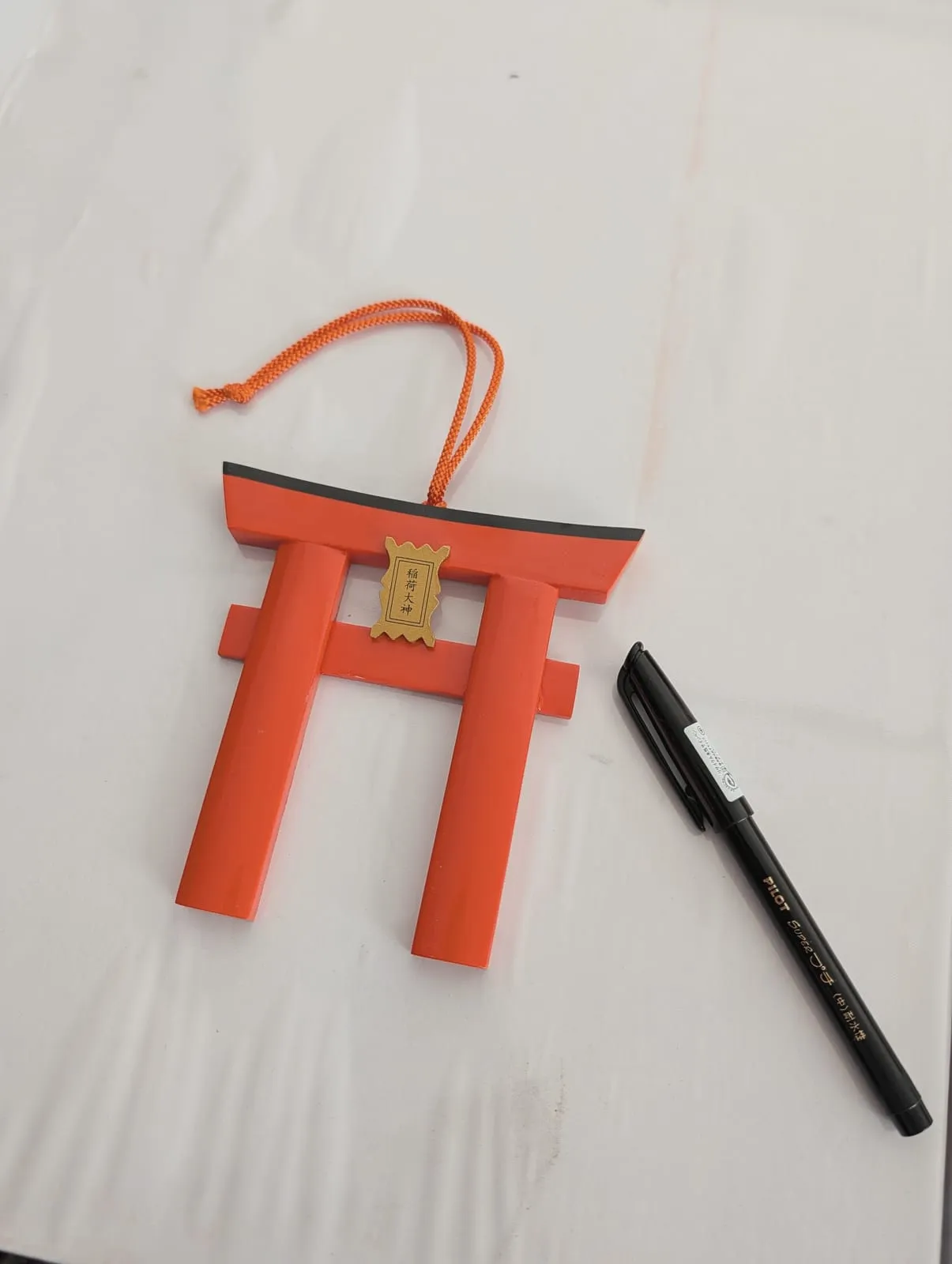
Not every ema has a blank back. The torii-shaped ema at Fushimi Inari is painted vermilion all over, and you write straight onto the gate. A small gold plaque on the crossbeam reads Inari Ōkami (稲荷大神), the name of the deity. At Fushimi Inari, pens are set out beside the racks.
Here is one we wrote, before and after.
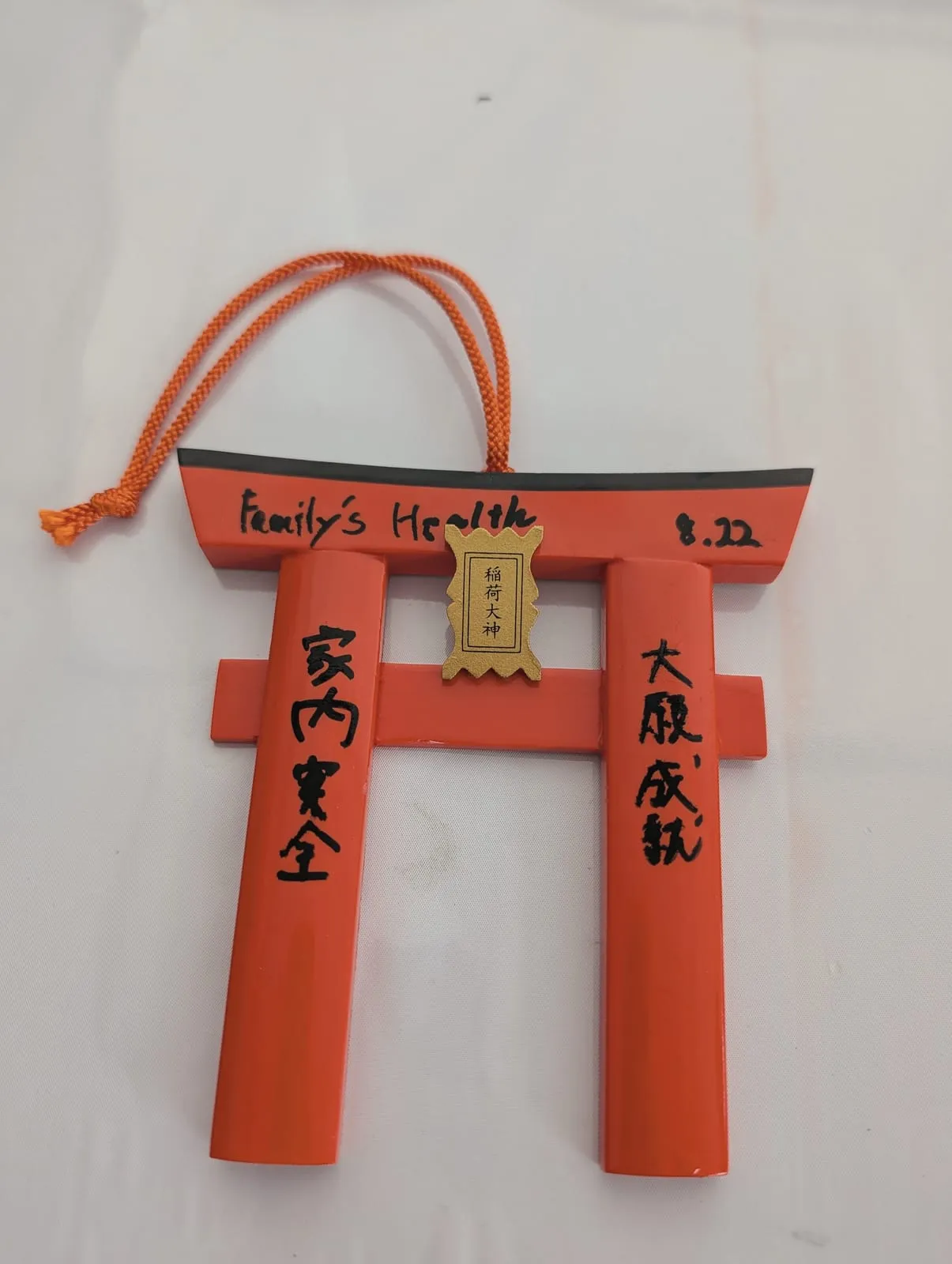
We used the three flat surfaces:
- Top beam: Family’s Health, in English, and the date, 8.22.
- Left pillar: 家内安全 (kanai anzen), a common wish for the well-being of a household.
- Right pillar: 大願成就 (taigan jōju), a wish for a long-held hope to be realized.
We left our name off this time. The Japanese phrases are set expressions, and you will see them on many ema. English on its own is just as fine. Ours is the large one on the right of the photo at the top of this page.
How to hang it
Every shrine that offers ema has a rack for them, usually near the main hall or the counter. Loop the cord over a hook or a rail. There is no set spot. People reach for an empty hook, or hang theirs next to a friend’s.
Racks differ as much as the plaques do. The one in the photo at the top is a wooden frame fitted with rows of metal hooks, set over gravel. The fox-face ema at Fushimi Inari hang on a vermilion wall under a roof, each on a thin purple cord.
Some guides list rules for what to do after hanging one. We only write what we see: people hang it, look at it for a moment, and walk on.
What happens to them afterwards
Ema are not meant to stay up forever. When a rack fills, or at certain times of year, shrine staff take the plaques down and burn them in a ceremony called otakiage (お焚き上げ).
Nobody comes back for theirs. That is the idea: you write it, you hang it, and you leave it with the shrine.
When this happens differs from shrine to shrine. We have not confirmed the timing at Fushimi Inari, so we leave it out here.
The fox-face ema at Fushimi Inari
Fushimi Inari’s best-known ema is shaped like a fox’s head: a white face, two pointed red ears, and an empty space where the features should be. Most people draw the eyes and mouth themselves. On one rack you will find foxes that look sleepy, fierce, and pleased with themselves.
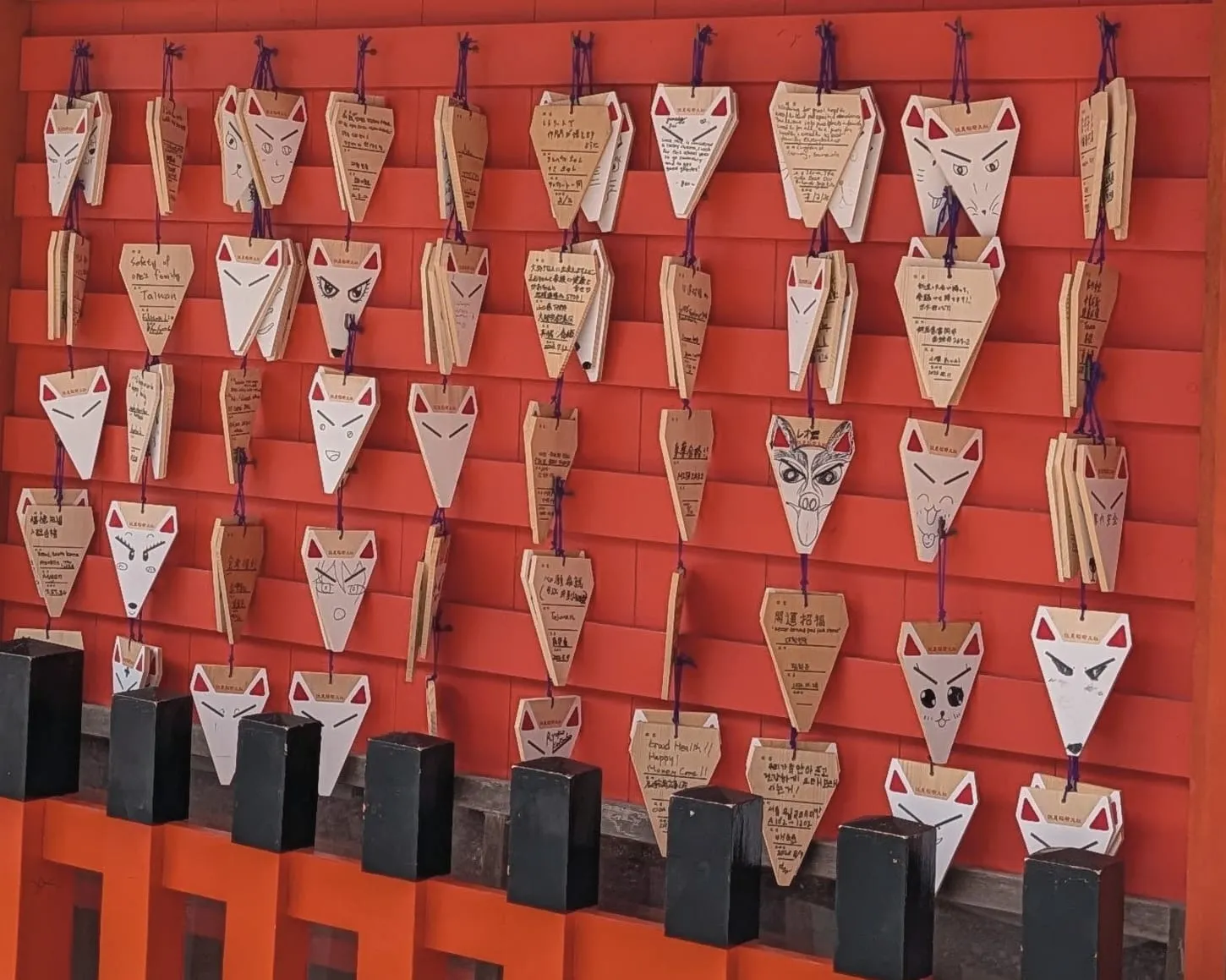
The face is printed white, with a small red stamp between the ears. The back is bare wood, and that is where most of the writing goes. On a full rack, some foxes hang face out and some hang wood out, so the wall reads as a pattern of white and pale brown.
You receive it at the juyosho, the same way as any other ema.
Field Notes
2026-08-22 14:10, clear
- On the rack of torii-shaped ema, English outnumbered Japanese, with several other languages besides.
- No wind that afternoon. The plaques hung still, and the rack made no sound.
- The rack was nearly full, with plaques layered several deep on most hooks.
FAQ
Can I write in English?
Yes. Anyone can write an ema, in any language. On the racks at Fushimi Inari, English sits next to Japanese.
Do I have to be Shinto or Buddhist?
No. Nobody at the counter asks what you believe, and people of every background write them.
Can I take an ema home instead of hanging it?
Some people do, and keep it as a record of the visit. Hanging it at the shrine is the original way.
How much does an ema cost?
It differs from shrine to shrine, and between kinds of ema at the same shrine. Shrines treat it as an offering rather than a price. At Yasaka Shrine, the amount was written on a card beside the tray.
A postcard from Kyoto
Kyoto is full of small things like this — a plaque, a fox, a gate, a slip of paper. Most visitors walk past them. We live here, so we notice.
Every month we choose a postcard for the season and write a few lines on the back by hand — what we noticed, and what the month is like here. Then we post it to you, or to someone you’re thinking of.
And, for a turning point
A new year, an exam, a move across the world. There is a smaller, older thing we can do on your behalf: walk to a shrine here in Kyoto, carry your wish, and send you a written report of the visit — photo-documented, so you can see it happened.
A separate service, ordered on its own. It is not part of the postcards.
About rituals