Fox Statues at Japanese Shrines: The Inari Kitsune Explained
Quick answer
The fox statues at Japanese shrines are kitsune, the messengers of Inari, the deity of rice. They are not the deity itself. Many hold something in their mouths: a jewel, a key, a scroll, or ears of rice. Many wear red bibs.
Messengers, not the deity
The foxes at Japanese shrines are kitsune (狐). They serve Inari Ōkami (稲荷大神), the deity of rice, and later of commerce and household prosperity. They are messengers, not the deity itself.
It is an easy mistake to make. Inari is not shown as a statue, so the foxes are the figures you actually see. At Fushimi Inari they sit beside the Romon gate, on pedestals beside the steps, and at almost every turn of the path.
In folk tales, kitsune are shape-shifters and tricksters. At an Inari shrine the foxes are white foxes (白狐, byakko), the deity’s messengers, and are treated as a separate kind from the foxes of folk tales. They stand guard at the gate.
What the foxes carry
Look at the mouths. Many of the foxes hold something, and the four you will see most are these:
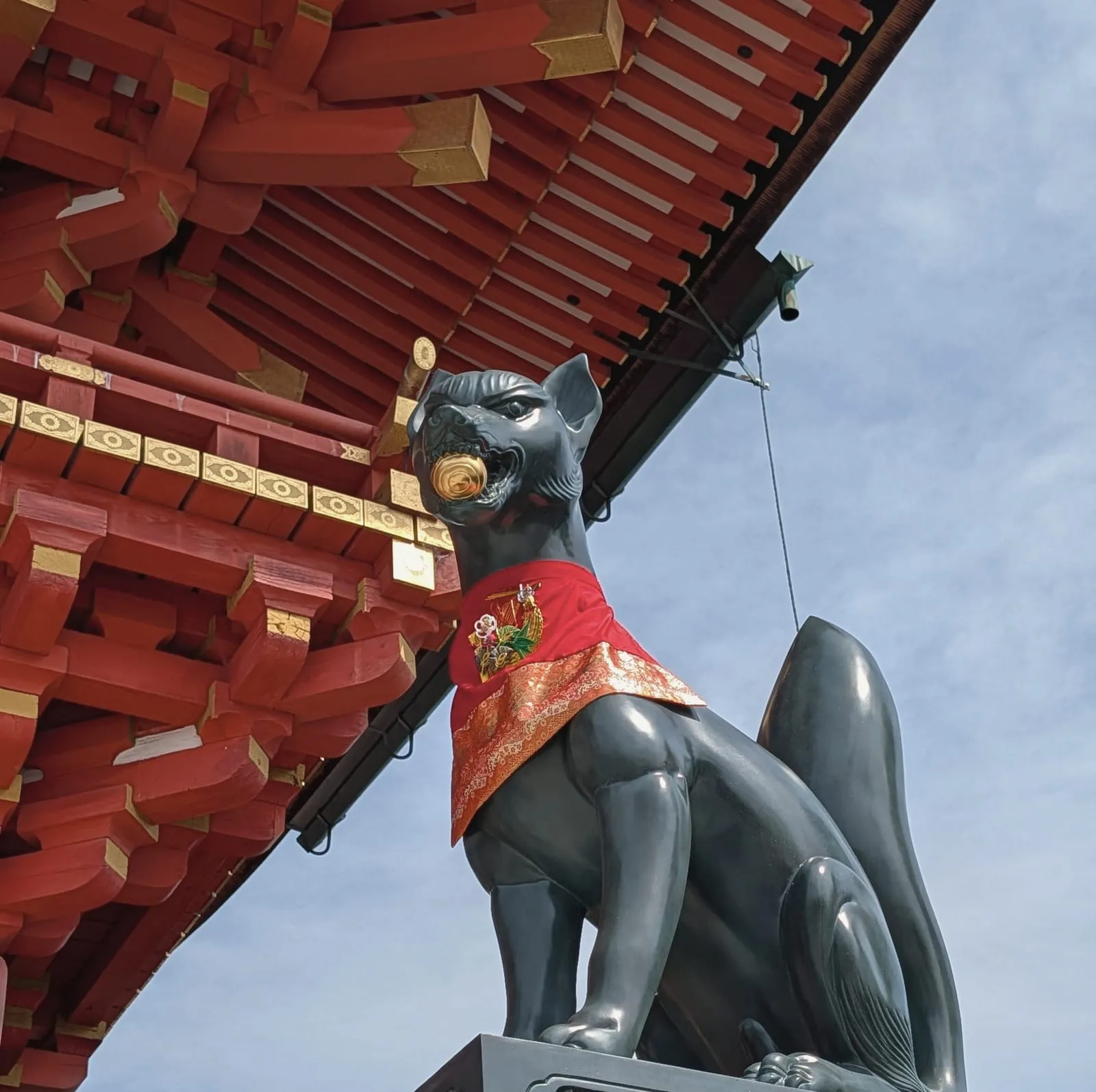
- A jewel (玉, tama; also called hōju, 宝珠). Usually read as the spirit of the deity. The fox beside the Romon gate, at the top of this page, holds a gilded one.
- A key (鍵, kagi). Said to open the rice storehouse.
- A scroll (巻物, makimono). Taken to be the deity’s teachings.
- Ears of rice (稲穂, inaho). Inari’s oldest tie: the rice harvest.
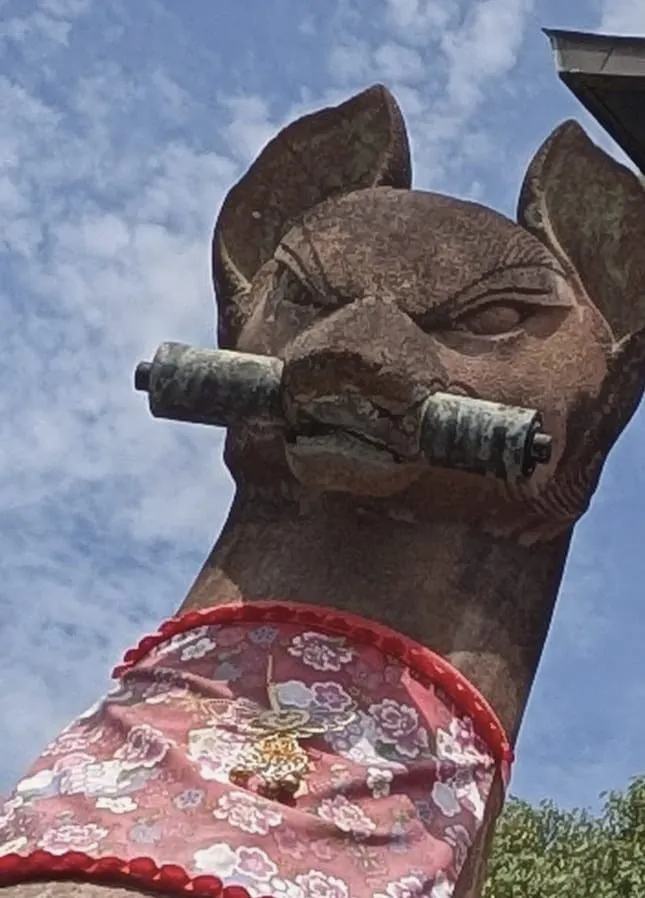
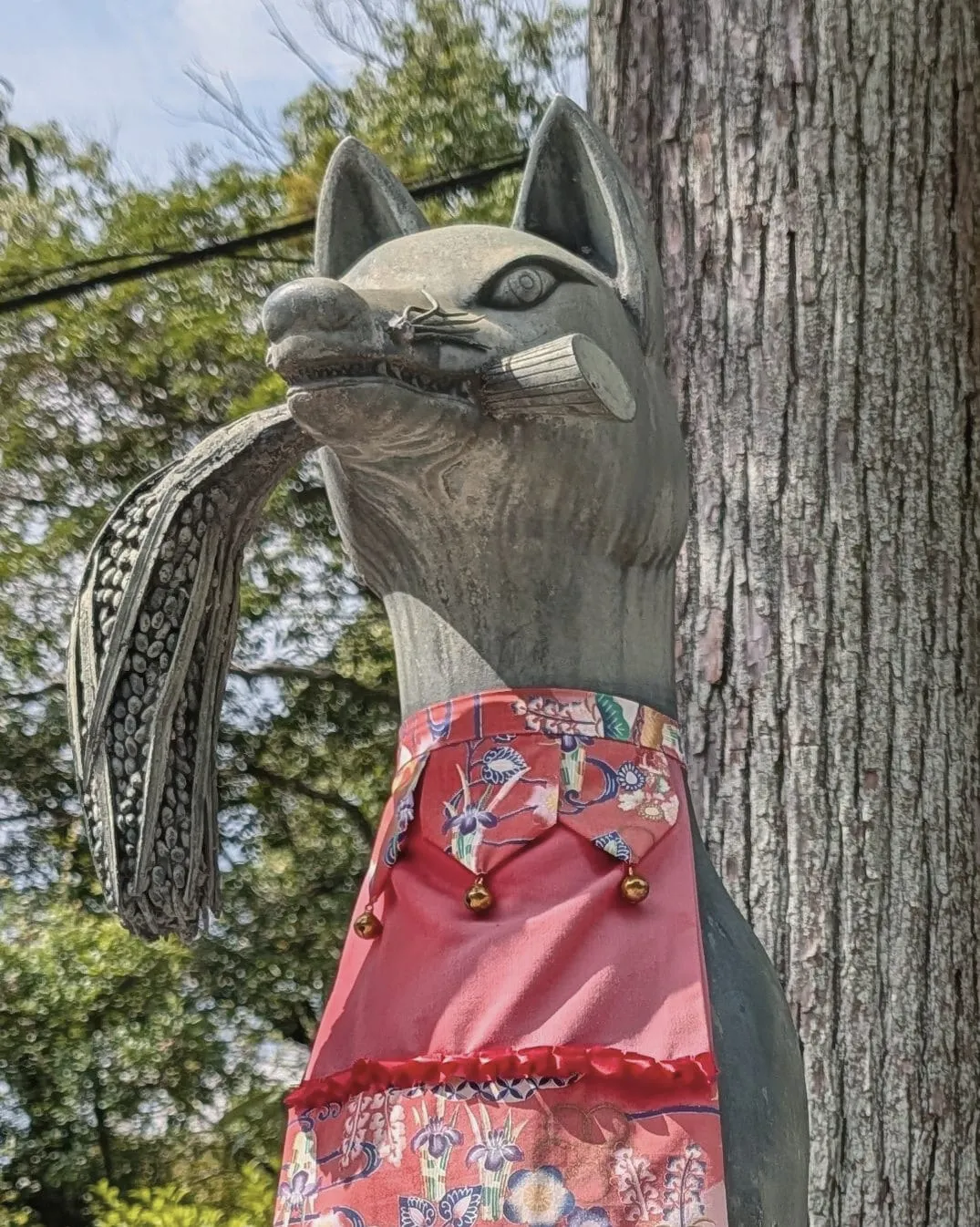
The fox on the left is stone; the scroll in its mouth is bronze, worn green at the ends. The rice on the right is bronze, a whole sheaf with the grains cast one by one, hanging past the fox’s chin.
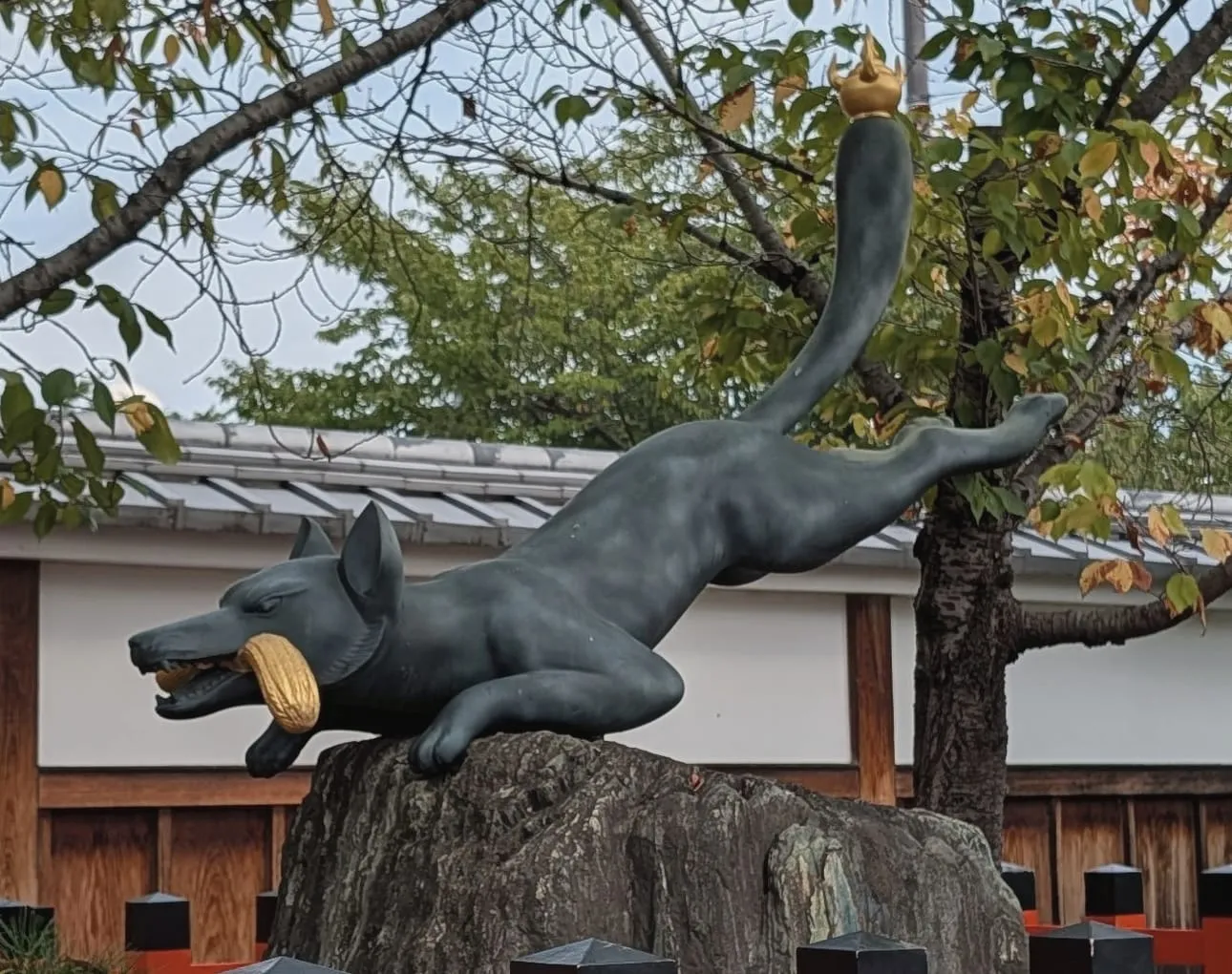
Not every fox sits still. This one leaps from a rock behind a vermilion fence, with gilded rice in its mouth and a golden jewel on the tip of its tail.
The fox turns up away from the statues, too. One kind of ema at Fushimi Inari, the wooden plaques people write on, is shaped like a fox’s face. We wrote about them in our guide to ema.
The red bibs
Three of the four foxes on this page wear a bib. The leaping fox wears none.
The one at the top has plain red with a gold brocade hem. The stone fox with the scroll wears pink cloth printed with flowers. The fox with the rice has three small brass bells along the edge of its collar.
The cloth is called a maekake (前掛け) or yodarekake (よだれかけ). Worshippers offer them, often as a way of giving thanks. The red matches the vermilion of the gates and halls around them.
How to treat the foxes
Visitors stop at fox after fox to take a photo, and many stand beside one for a picture of their own. That is fine. The statues themselves are left alone: no hands on them, no climbing, and nothing placed in their mouths. The pedestals and the vermilion fences around them are not for standing on. The bibs were offered by worshippers, so they stay as they are, not straightened, removed, or taken home.
Fox or lion-dog?
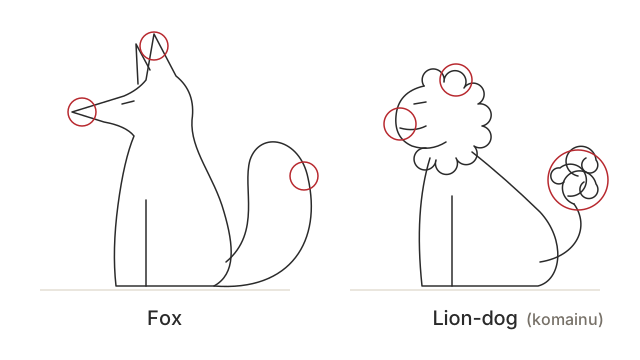
Many shrines keep a pair of lion-dogs, komainu (狛犬), at the gate. From a distance they are easy to take for foxes. Three things tell them apart:
- The muzzle. A fox’s is long and narrow. A lion-dog has a round face, closer to a lion’s.
- The ears. A fox’s stand up in points. A lion-dog’s are hidden in curls of mane.
- The tail. A fox’s is thick and full. A lion-dog’s is carved in curls, like its mane.
Why Inari has foxes
No one knows for certain how the fox came to serve Inari. The explanation you hear most is plain. Foxes lived at the edge of the rice fields, and they hunted the mice that ate the grain.
Another explanation points to the season: foxes were seen near the villages in spring and gone by autumn, the same calendar as the rice.
Inari shrines across Japan keep foxes for the same reason. If a pair of foxes stands at a shrine’s gate, it is most likely an Inari shrine.
A spotter’s list for your walk
Six things to look for on the way up:
- A jewel
- A key
- A scroll
- Ears of rice
- A red bib, or none
- Sitting, or leaping
Field Notes
2026-08-22 14:10, clear, hot
- Foxes at every turn: beside the Romon gate, on pedestals beside the steps, on a rock behind a fence.
- Visitors from abroad stopped at fox after fox, to take a photo of it, or of themselves standing beside it.
- Some foxes were bronze and some were stone. The gilded jewels and rice caught the afternoon sun.
FAQ
Are the fox statues gods?
No. The foxes are messengers of Inari, not the deity itself. Inari is not shown as a statue, so the foxes are the figures you see at the gates and along the paths.
What are the foxes holding in their mouths?
Most often a jewel, a key, a scroll, or ears of rice. Some are gilded, and some foxes carry a jewel on the tip of the tail as well.
Why do the foxes wear red bibs?
The bibs, called maekake or yodarekake, are offered by worshippers, often as a way of giving thanks. The red matches the vermilion of the shrine's gates and halls.
Does a fox statue mean the shrine is an Inari shrine?
Usually, yes. Foxes belong to Inari, so a pair of foxes at the gate is the easiest way to tell.
A postcard from Kyoto
Kyoto is full of small things like this — a plaque, a fox, a gate, a slip of paper. Most visitors walk past them. We live here, so we notice.
Every month we choose a postcard for the season and write a few lines on the back by hand — what we noticed, and what the month is like here. Then we post it to you, or to someone you’re thinking of.
And, for a turning point
A new year, an exam, a move across the world. There is a smaller, older thing we can do on your behalf: walk to a shrine here in Kyoto, carry your wish, and send you a written report of the visit — photo-documented, so you can see it happened.
A separate service, ordered on its own. It is not part of the postcards.
About rituals